
Our Planet Needs More Nature Enthusiasts
By Adam Simon
October 2023
All photos displayed below are my own.
(Warning to people with fear of snakes.)
I believe that the 21st century has already resulted in incredibly positive changes contributing to the advancement of humankind, but unfortunately many new problems also surfaced alongside the positive changes. Recent technological progress combined with urbanisation and consumerism resulted in a disconnection from nature. The natural world needs human caring to prevent irreversible damages as well as humans greatly benefit from being connected with nature. The consequences of humanity distancing itself from nature can be felt on both sides.
My recent personal experience being involved with the Biodiversity Literacy project suggests that the solution could lie in the people we surround ourselves with and the openness to take on new and sometimes weird passions. For me, this passion is Herpetology (the study of reptiles and amphibians), but I think it doesn’t matter if we like reptiles or birds, something as small as a ladybug or something as big as a blue whale, the important thing is that we are all inherently connected to nature, we are a part of it and we couldn’t exist without it even if we wanted to.
The conservation of biodiversity should be a crucial priority of the coming generations, since humanity relies on nature for so many services including food safety, climate regulation, new medicines and cultural or recreational values.
Overall the three main exposures to me were observing animals in nature as a child, being responsible for my pets and then getting indoctrinated into the scientific side of biology developing my main interest in conservation or ecology. This blog will follow these different life experiences I had, explain how they relate to biodiversity conservation and try to draw a conclusion about how we can induce a reconnection with our ever-so-curious inner child.
Childhood
Since my parents aren’t Biologists, I think an incredibly important first step leading towards who I am today was that I spent most of my summers at our lakeside house at Lake Balaton (Photo 1). Most children are interested in almost anything they come across. For me these were the animals I found in the swampy parts of the lake where I spent several hours each day looking for reptiles like the dice snake and several frog species as well as any other critters I could come across.
Additionally, both my parents have a strong love for nature which resulted in spending a lot of time outdoors through hiking/mountaineering, camping, scuba diving/snorkelling or skiing. From a young age, I have been exposed to these activities which I believe was another prerequisite to fuel my curiosity about my surroundings and environment and give me a head start on my biological career.

Photo 1: Sunset at lake Balaton in Hungary
These adventures included helping turtles who were trying to cross the road, but of course my curiosity got the better of me and I kept it for a moment to wonder at the creature before releasing it back to the wild (Photo 2). I was 8 at the time and over the years I developed a strong connection to this small corridor of nature that I could call mine.

Photo 2: European pond turtle (Emys orbicularis)
Adolescence
My love of reptiles turned a little bit away from their natural setting as high school and my teenage years grounded me in Budapest for most of my time. The way I managed to get around not being in nature was to bring a part of it into my room. I still can’t believe and thank my parents enough that they put up with this passion of mine. Over the years I kept several geckos, chameleons (Photos 3 and 4), and snakes and to feed them I also housed crickets, cockroaches, locusts and occasionally mice.

Photo 3: My crested geckos (Correlophus ciliatus)

Photo 4: My panther chameleon (Furcifer pardalis)
To provide these animals with the best life I could give them I had to read about them for hours and hours sometimes staying up until late at night disregarding the fact that I had to wake up for school the next morning. I extensively researched different topics connected to keeping reptiles including: their dietary requirements like vitamin supplements, what kind and combination of insects each species needs, what kind of UVB lights they need for proper bone development, how much moisture they need to enable them to drink from surfaces and which plants are not toxic to them.
Young adulthood
After moving away from reptile keeping, I tried seeking opportunities to engage with animals in the field through University. I didn’t believe first when I found out I had been accepted to study abroad for a semester in Australia. It opened so many new opportunities for me to connect with herpetologists and see as many animals in their natural habitat as possible. Australia has more than 1000 reptiles species and the overall high biodiversity meant there was so much for me to discover.
On every holiday I was looking for animals trying to ID them, learn more about them and engage my non-biologist friends to do the same. I saw countless fascinating creatures like wombats, echidnas, saltwater crocodiles, land crabs, orb weaver spiders and several more. One of my favourite memories was on a hike when someone stepped over a large stick to realise it was a 2.5 meters long python and while everyone was running away from it, I was running towards in awe (and to take some photos of course) (Photo 5).

Photo 5: Australian scrub python (Simalia kinghorni)
To gain some field experience I volunteered under two PhD students running projects on reptile ecology and conservation where I learnt about pitfall trapping, relocation and radio-tagging methods amongst others (Photo 6). This made me realise I want to spend the rest of my life doing field work to help learn more about animals and their conservation.
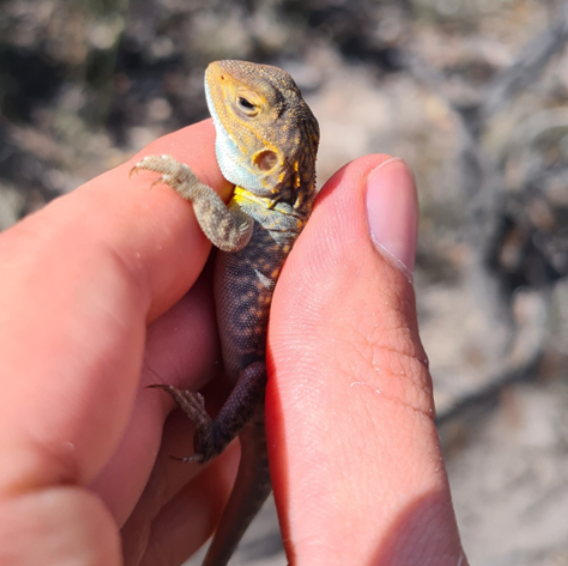
Photo 6: A Painted dragon (Ctenophorus pictus) waiting to be radio-tagged before relocation.
Biodiversity literacy
I have been studying in Scotland for more than 3 years and I discovered quickly that it's rarely possible to see reptiles here. To put it into perspective Scotland has 4 reptile species, Europe has more than 150 and Australia has more than a thousand. However, Scotland has a diverse birding scene so it would have made sense to get passionate about birds in fresher year which unfortunately didn’t happen as I was always looking for distant dreams and opportunities rather than living in the present. Starting the VIP I never thought I could get hooked on birds as easily as I did next to Professor Will Creswell who runs the project. His knowledge and passion towards birds is contagious and now I can’t not turn my head like an owl any time I see a shadow flying above my head. I think having radiating passion towards any aspect of nature will influence people in our surroundings to at least spark curiosity towards nature.
Our planet needs more nature enthusiasts, and the solution may lie in promoting cultural changes where knowledge and passion for the natural world is passed on from parents or mentors who shape our thinking and curiosity.