
Foraging for Biodiversity: How Wild Foods Can Help Us Connect with Nature
By Eliza Boyd
November 2024
Foraging is the practice of gathering edible plants, fruits, mushrooms, and more from the wild. It’s a hands-on approach to learn about local species and the ecosystems they are a part of, and this interaction fosters an understanding of the importance of these native plants. Not only do you learn to identify edible flora, but also when and where they grow, and what wildlife lives off of them.
Recently, I have become very interested in mushrooms and fungi. I have always been intrigued by the alienness of them; they appear and fade so quickly and make a variety of weird shapes. However, I had always been hesitant to eat them as I was cautious of ill effects. After a walk with an experienced friend, who showed me some easily identifiable mushrooms, I realized that perhaps it did not matter whether it was edible or not, and that exploring my knowledge of the fungi was a valid endeavour in itself. Of course, I am keen to find ones I can eat, but on the way to this goal I have begun to notice so many mushrooms and fungi everywhere that I had not before!


Mushrooms found outside University Hall that I have walked past many times without noticing!
Understanding the roles of different plants and habitats can deepen appreciation for biodiversity and the importance of conserving it. When done responsibly, foraging builds respect for our natural spaces, helping people to be more conscious of the need to protect these areas and avoid actions that are detrimental to these species.
This is where the biodiversity literacy VIP comes into the picture. We are group of students from different academic backgrounds, who are working towards a few different biodiversity-based goals. Within this, we are running a project to improve the way some areas of the University Campus are managed and increase their commitment to biodiversity. Shortly after finding the mushrooms above, they were mown by the University management. I definitely had a stronger reaction than I would have had before noticing these mushrooms to the unnecessary cutting of this lawn, and am much more invested than before.
However, the main aim of this module is to increase people’s awareness of the biodiversity around them, so that a cultural, bottom-up shift can happen. We want to get as many people involved with their local nature as possible so they can make decisions to improve and conserve biodiversity.
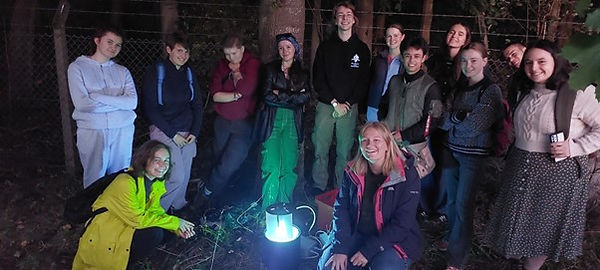
VIP group surveying moths!
Getting Started with Foraging – A Beginner’s Guide
When I am out in the moors and mountains of the UK I am always looking for bilberries. They are a small blue fruit that looks very similar to a blueberry, and goes by many different regional names: Blaeberry and Hurts in Scotland, Wimberry in northern England, and Whortleberry in southern England. They are well known as a tasty nibble found on the hills and are very distinctive; they have a deep blue-black-purple skin and dark purple flesh when ripe, that stains fingers and mouths purple. The plant has green, oval shaped serrated leaves that turn red in autumn, as shown below.

Bilberry bush
When beginning foraging, it is important to be confident at identifying the plants you are thinking of eating. Attending workshops such as those offered by Transition and using field guides/apps are fantastic ways of learning to identify species. A great example to start with is blackberries, which grow on brambles around St Andrews in abundance in late summer. They are easily identifiable by their distinctive fruit, thorny stems and jagged leaves and don’t have many look-alikes – when you think you have identified a species, it is good practice to check for look-alikes to avoid a nasty surprise!


Blackberries and the wildlife that can rely on them – a water vole!
It is also very important to forage ethically and sustainably. Making sure to only pick what is needed helps conserve natural resources and allows for regrowth. These plants and fungi are often an essential part of an ecosystem, and so leaving enough for wildlife to eat and use as a habitat is essential. As long as you only choose abundant plants, and leave younger ones to grow, this is easy to do. When picking, try not to damage other species around them, and use the right tools to avoid damage to the plant (e.g scissors, knife).
When deciding what to pick, the legality of this should also be considered: anything growing wild must be picked for personal consumption only. In the UK, most wildly growing species, aside from those specifically protected* and seaweed, are legal to harvest without permission. For seaweed, you must obtain permission from the land owner. In the case of the Crown, small bits are allowed to be taken provided you take into account of the environmental sensitivities of foraging seaweed.
So, get on out there and find some edible plants! Try starting with familiar, easy to identify plants, like blackberries or bilberries. Reach out to that whacky aunt that walks barefoot through woods, get involved with some experienced people, it’s the best way to learn!
The Broader Impact of Foraging on Biodiversity Conservation
For me, the search for edible plants has opened up a whole world of biodiversity that was there all along. From knowing and seeing very little of the plants that are actually around me, to noticing and appreciating all the little things. This, alongside the VIP project, has allowed me to contribute my part to the local conservation efforts and will inform my future decisions. Others can be influenced in the same way by getting involved with community conservation efforts (such as the biodiversity working group in St Andrews). I strongly encourage you to explore foraging to discover biodiversity, respect nature, stay safe, take only what you need, and share experiences. Join local groups and projects to protect ecosystems and celebrate nature’s wonders.
* List of prohibited plants : https://www.legislation.gov.uk/ukpga/1981/69/schedule/8