
The Art of Noticing – BioLit Edition!

There’s an idea I came across in a random post online that people don’t notice the same world. Walk with a typographer in a presumably boring town, and they’ll point out all the cool fonts no one else notices. The same applies to biodiversity.
The trees in your garden and the birds you pass on your way to lectures might be extraordinary, but if a person doesn’t notice them, they’d never know. This was me.
…
A long, long time ago… or just recently actually, every bird was just a bird to me. Don’t get me wrong – I’ve always liked birds. But I didn’t really know them.
Then I stumbled upon the Biodiversity Literacy VIP.
For those who don’t know, the Biodiversity Literacy VIP is about learning how to see the natural world properly, monitoring and identifying species, and contributing to a wider effort to understand and protect the biodiversity around the University of St Andrews!
Though, before I joined it, I was so aware of how little I knew that I PANIC-BOUGHT the RSPB Pocket Guide to British Birds, flipping through the pages and thinking there was no way I would remember all of this.
At this point in time, my interaction with nature was limited. I took occasional walks to “touch grass” and escape the stereotypical Computer Science student lifestyle, along with the odd moments of scanning unknown plants on an app to satisfy my curiosity. But that was it.
The Start of Noticing
See my below photography:

Past me would have just pointed and said, “ducks!”, and nothing else.
But now I know these are male and female mallard ducks (scientifically, anas platyrhynchos)
To get into identification terms…the males are easy to spot with their yellow bills, glossy green heads, white neck rings and rich violet-brown chests. The females, on the other hand, are mottled brown with a pale eyebrow, a dark eyestripe and a mostly orange-brown bill.
And here’s a fun fact I learnt from another VIPer:

Every female mallard has a uniquely patterned bill, like a fingerprint!
…
Then outside of mallards, I (surprisingly) began to naturally learn the differences between other birds.
I gradually realised that all the similarly looking black birds I saw weren’t just “crows”, and gulls weren’t just “seagulls”. There are carrion crows, rooks, jackdaws, and hooded crows, each with their own distinct features. Similarly, gulls are far more diverse than I had assumed. In St Andrews alone, there are many different kinds, including the herring gull (the most dramatic of them all).
It felt almost rude of me, like I had been calling everyone by the same name for years.
For example, imagine walking into a room and pointing:
“Human.”
That’s what I had been doing to these birds.

…
As I went on more bird walks and became more involved with the VIP, my domain of natural knowledge expanded.
Being able to identify these birds and learn fun facts made me realise that there was much more going on in the natural world than I had previously thought.
In my past ignorance, I didn’t realise I was constantly walking past an entire world.
Next…Learning to Listen
Being a busy and stressed-out university student, there were always other things constantly racing through my mind. I’d equipped headphones and blast my ears with music, while rushing through town from one lecture to another.
I’m sure that’s common for most students. Days are hectic and “assignments, exams, studies…” become an endless loop.
Additionally, as a Computer Science student, I was either stuck in labs or stuck in my room.
Because of this, I never stopped to notice all the sights and sounds around me.
And as someone who barely knew how to identify birds at the time, it’s harder to tell what species a speck of fluff was, in the millisecond it decided to grace you with its presence before skedaddling off to some unknown plane.

But it’s different with sound.
When you walk through St Andrews, you can hear a variety of calls–mainly gulls, but also the tseeps, clicks, caws and tweeps coming from trees, hedges, rooftops and the sky (especially if you’re subjected to early morning lectures like me).
Though sound was much easier to notice than sight, it was still just pleasant background noise, as I didn’t know how to distinguish any bird calls…yet.
But that changed after a VIP bird walk focusing on identification by sound. What really helped was the memorable bird impression our supervisor Will did of a water rail, I’ll never forget it.
So, it turns out one of the easiest ways to start noticing and identifying birds is simply to build fun associations!
For example, here’s a snippet of my list:
- A wren sounds like an arcade shooter machine
- A great tit sounds like a tiny bike pump
- Jackdaws and chiffchaffs sound like they’re saying their own names (like Pokémon!)
And then once you establish these connections, you cannot unhear them.

…
There was a moment where my friend and I paused our conversation after hearing birdsong erupt from a tree. We stood still with our heads tilted, trying to listen and guess what was singing (it was a blackbird). Then, in that moment, I just remember thinking: “how did I never notice this before?”
Now, I regularly find myself stopping mid-walk. Instead of sealing myself off from the world with music and anxious thoughts, I’m listening and participating- guessing, sometimes getting it wrong, and sometimes getting it right! It’s a satisfying feeling. I still have far to go, and there’s so many bird songs and calls that I accidentally mix up, but that’s a part of the journey.
P.S. If you’re new to bird identification, apps like Merlin can really help. It has images and sound recognition which can hold your confused hands as you step into the world of noticing…then eventually you begin to naturally recognise patterns yourself.
You’d also be surprised at how many birds there can be on an average five-minute walk between university buildings.

Why Noticing Matters
This might seem like a small thing. Just learning bird names or how to identify them by sight or sound. But the act of noticing changes how you experience the world. When you begin noticing small details in nature, everything becomes richer.
And that’s the magic of noticing!
It’s good for your mental health in a way I didn’t expect. Something as simple as listening to birds (or spotting them) can feel surprisingly grounding. It’s like walking barefoot on grass or feeling the warm sunlight hit your face.
Connecting with nature makes you feel more alive and the world becomes much more colourful.
And it builds a quiet confidence! Knowing something specific and real, being able to say, “Hey, these are oystercatchers,” and “Did you know they can fly at speeds of up to 40 mph?”, instead of just “birds”.
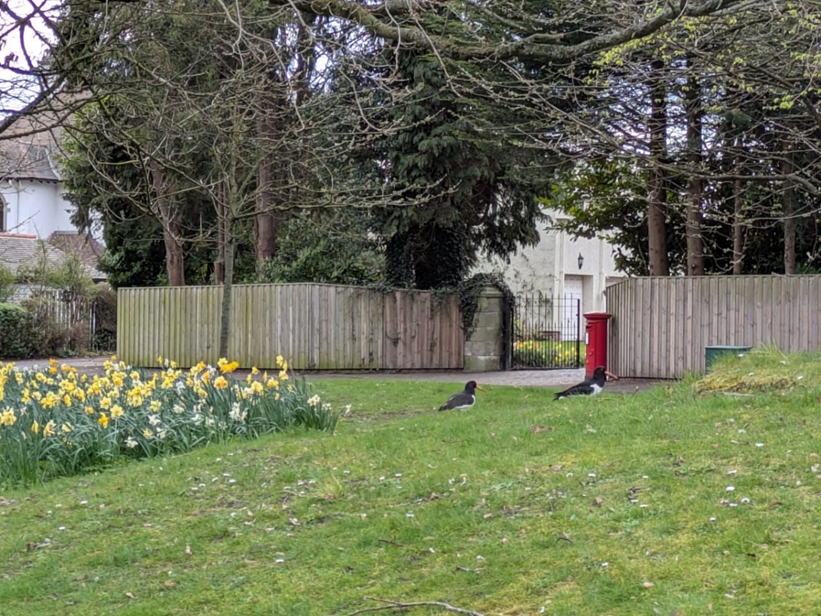
When you name something and notice it, you care about it. And when you care about it, you protect it.
There is a simple truth in conservation: people protect what they care about, and people care about what they notice. If every bird is just “a bird,” then biodiversity feels abstract and distant. But when that bird becomes: a robin, a jackdaw, a chaffinch, a blackbird, a long-tailed tit…it’s harder to look away.
You start to realise that the world isn’t just a backdrop; it’s full of living things with their own patterns, behaviours, and rhythms…
You build a connection to the critters you notice, and that connection changes your relationship with nature, and with yourself. It makes you more present in the world, not just with living things but with your surroundings as a whole.


What Changed For Me
Now, as I finish my time in the Biodiversity Literacy VIP, it’s funny to think about how nervous I originally was, panic-buying a bird guide and worrying I wouldn’t know anything.
Many students in the group seemed like bird experts, and I was very much a beginner. I was worried that I wouldn’t fit in or that I would fall behind, but then that fear disappeared almost immediately.
The VIP environment is incredibly welcoming, and students from different years share knowledge openly.
I only took this VIP for a semester, but it was genuinely worth it and, in many ways, life changing. I still have a lot to learn, but I’ve gained the inspiration to continue my explorations of biodiversity, even outside the module. It changed the way I see the world.
What used to be background noise is now a language. What used to be limited knowledge is now dozens of species and ways to distinguish them. What used to go unnoticed is now impossible to ignore.
And perhaps the most important thing the VIP taught me is this: the world was always beautiful; I just hadn’t been paying attention.
By the time you finish reading this, I sincerely hope you think, “This makes me want to go outside right now and notice more nature.”


Comments